song without an ending
Curated by Cristiano Raimondi, Societa Delle Api, Monaco
14 April 2022 – 22 July 2022
Text by Ben Eastham
“Hello, the roses”
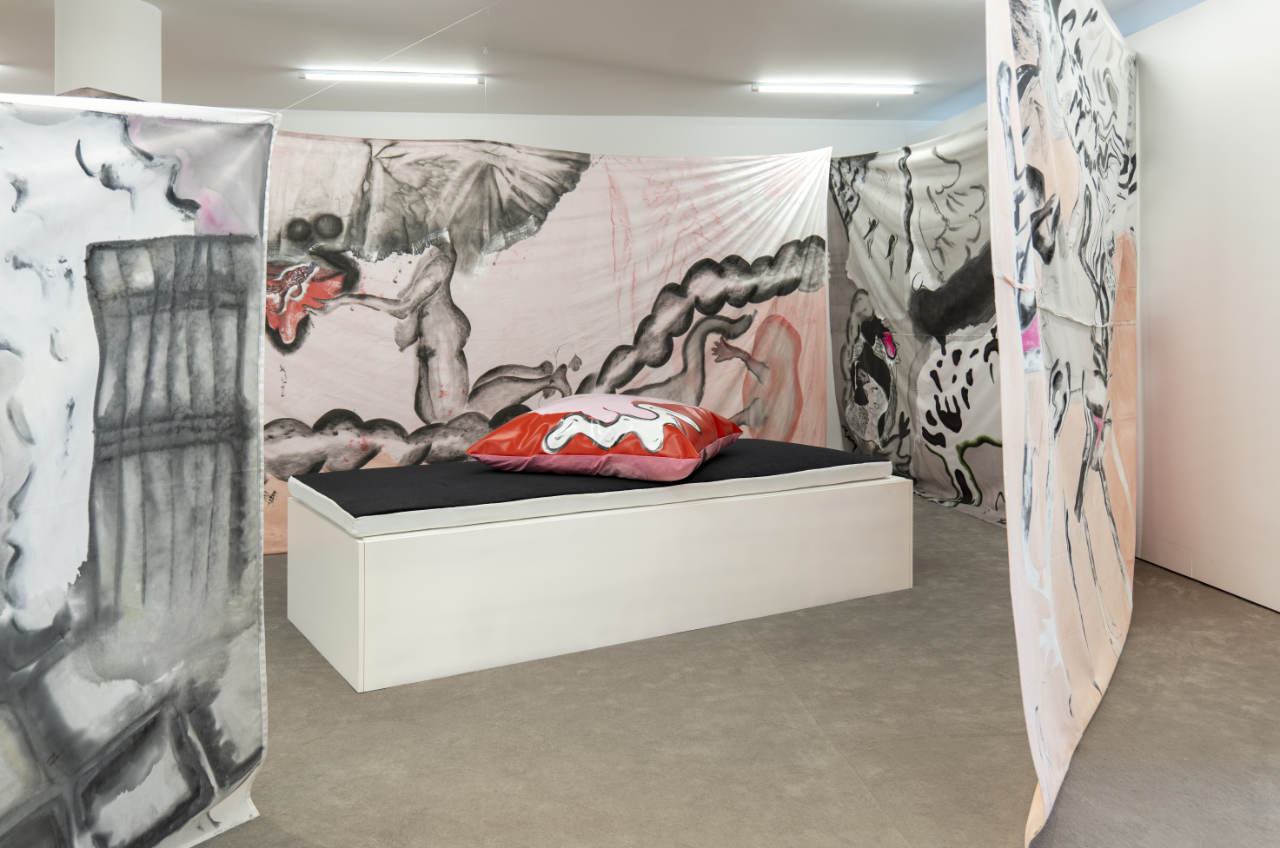
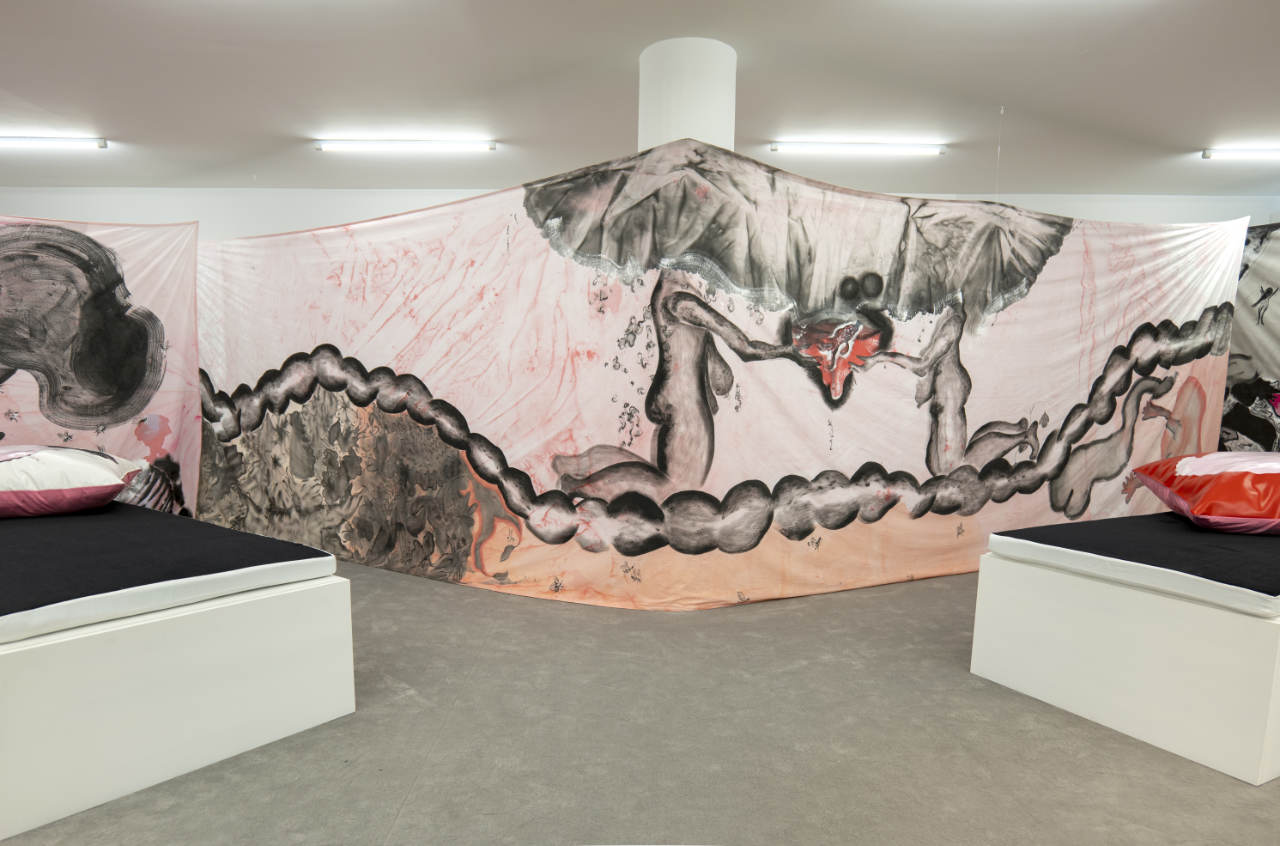
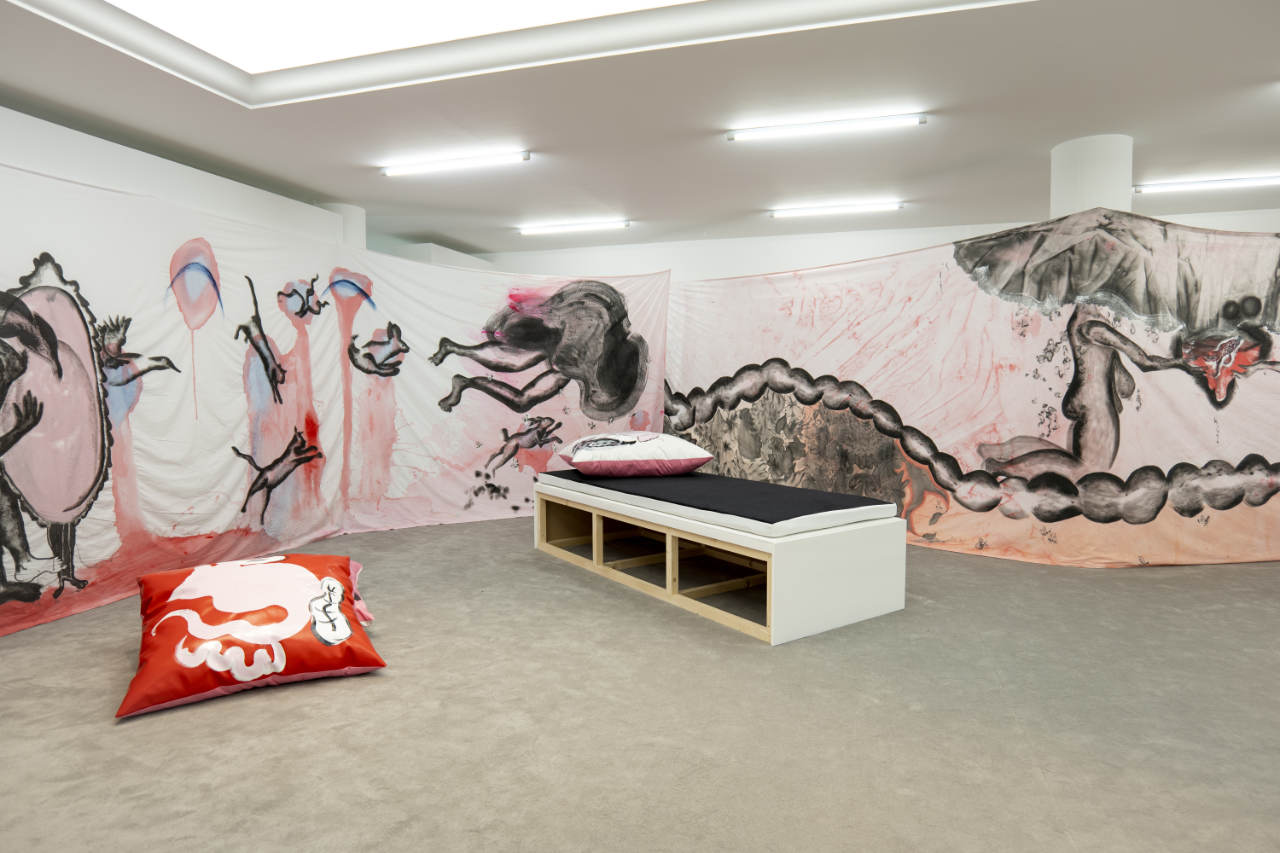
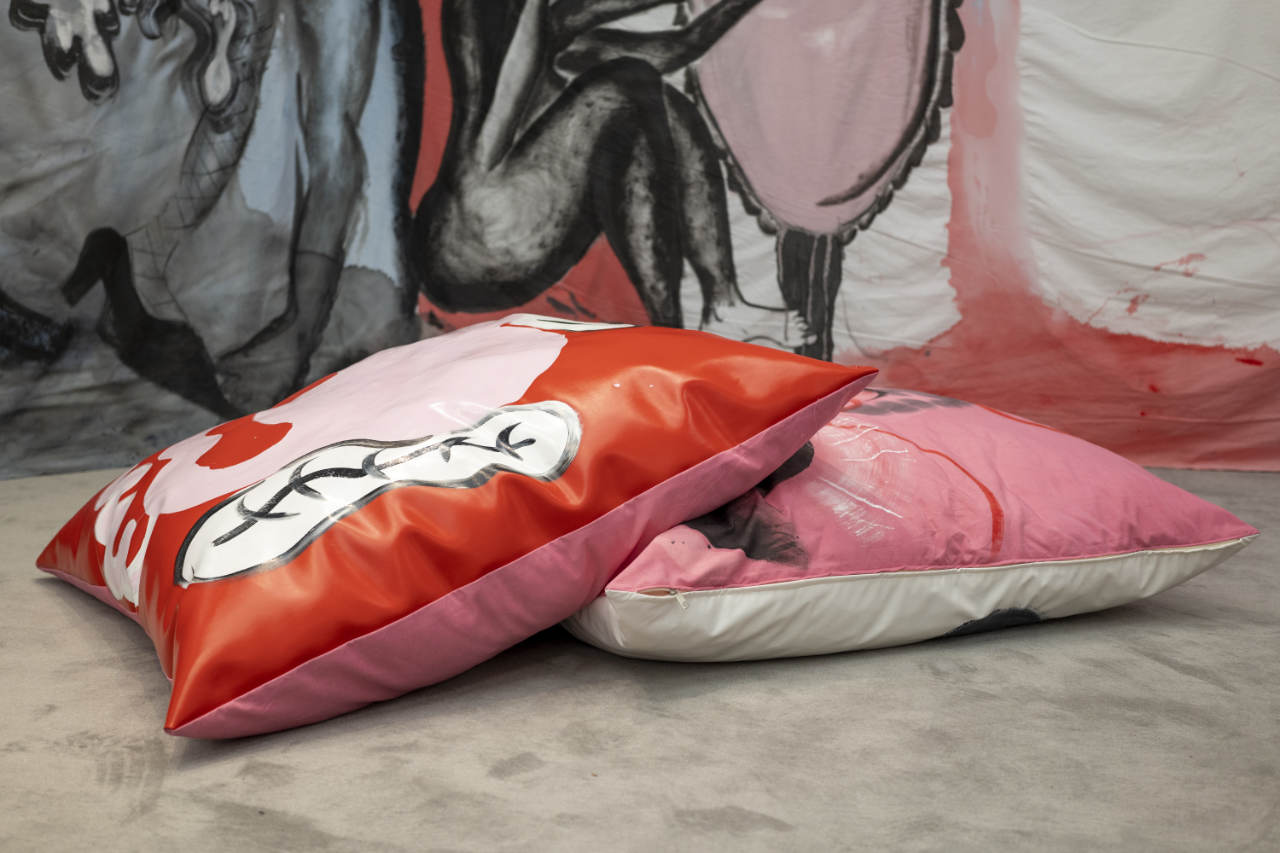
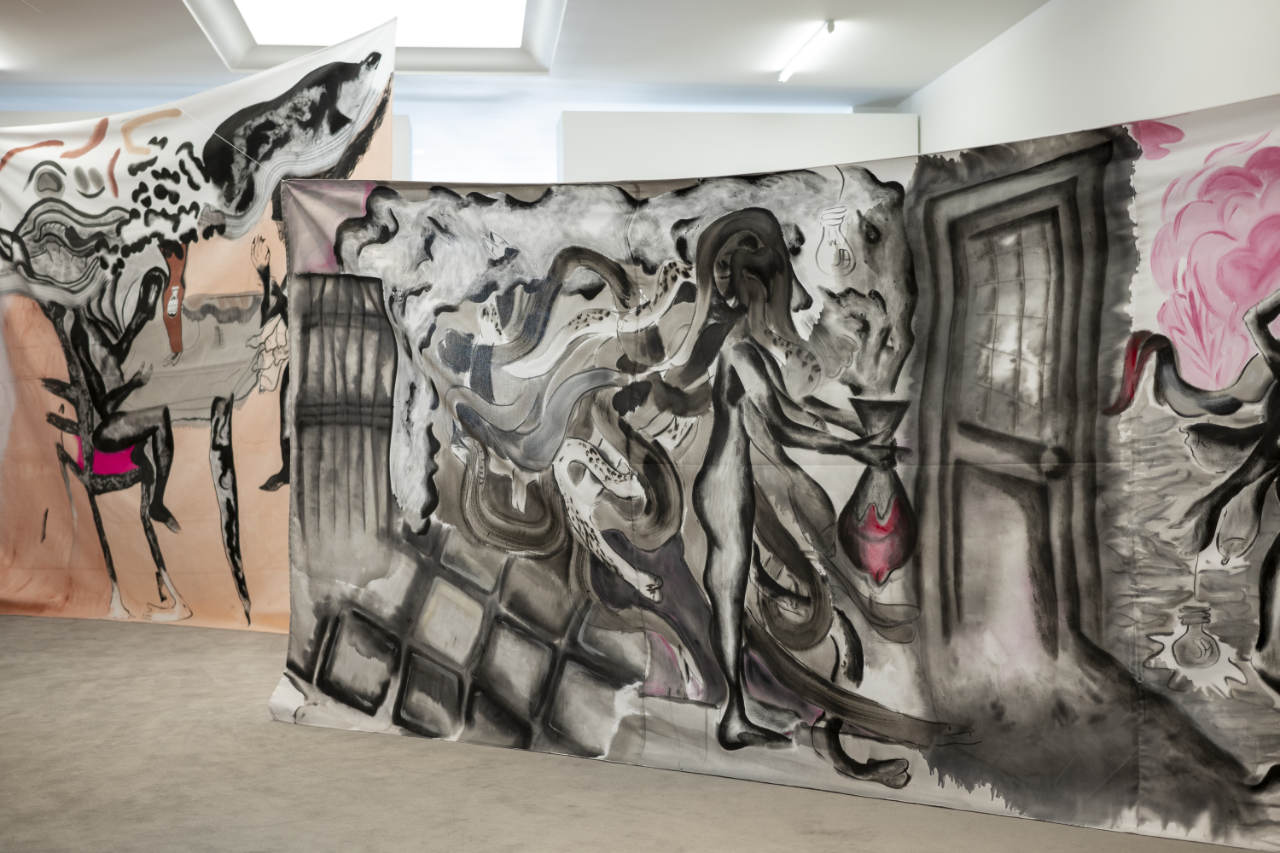
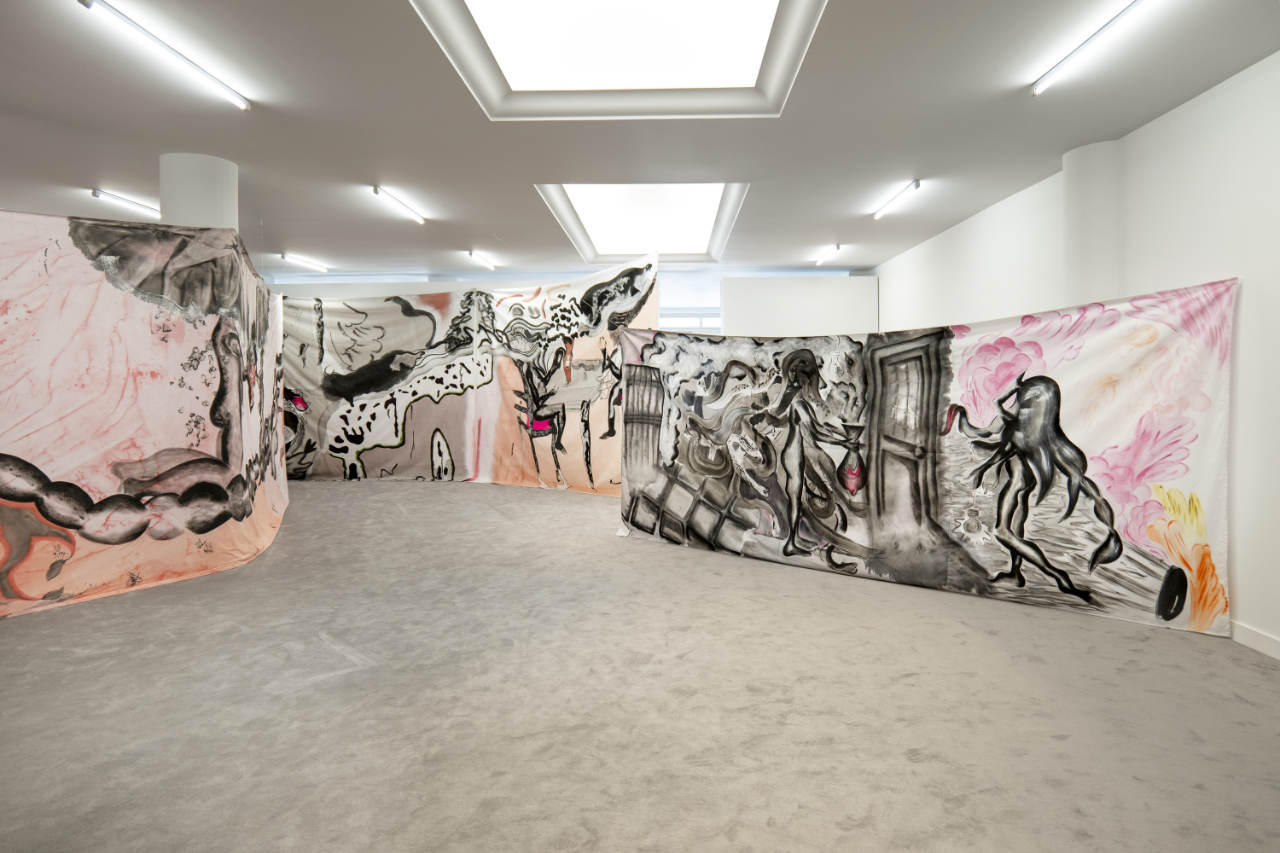
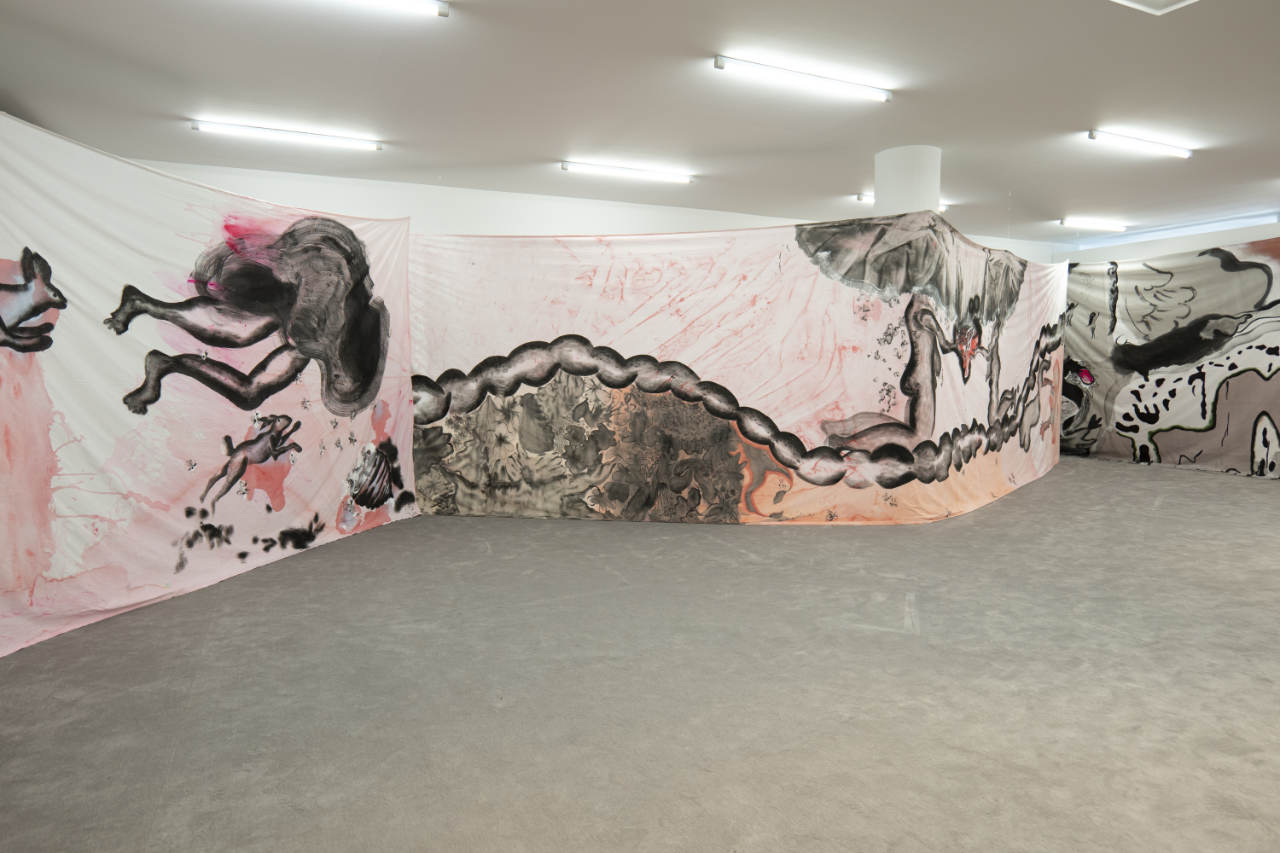
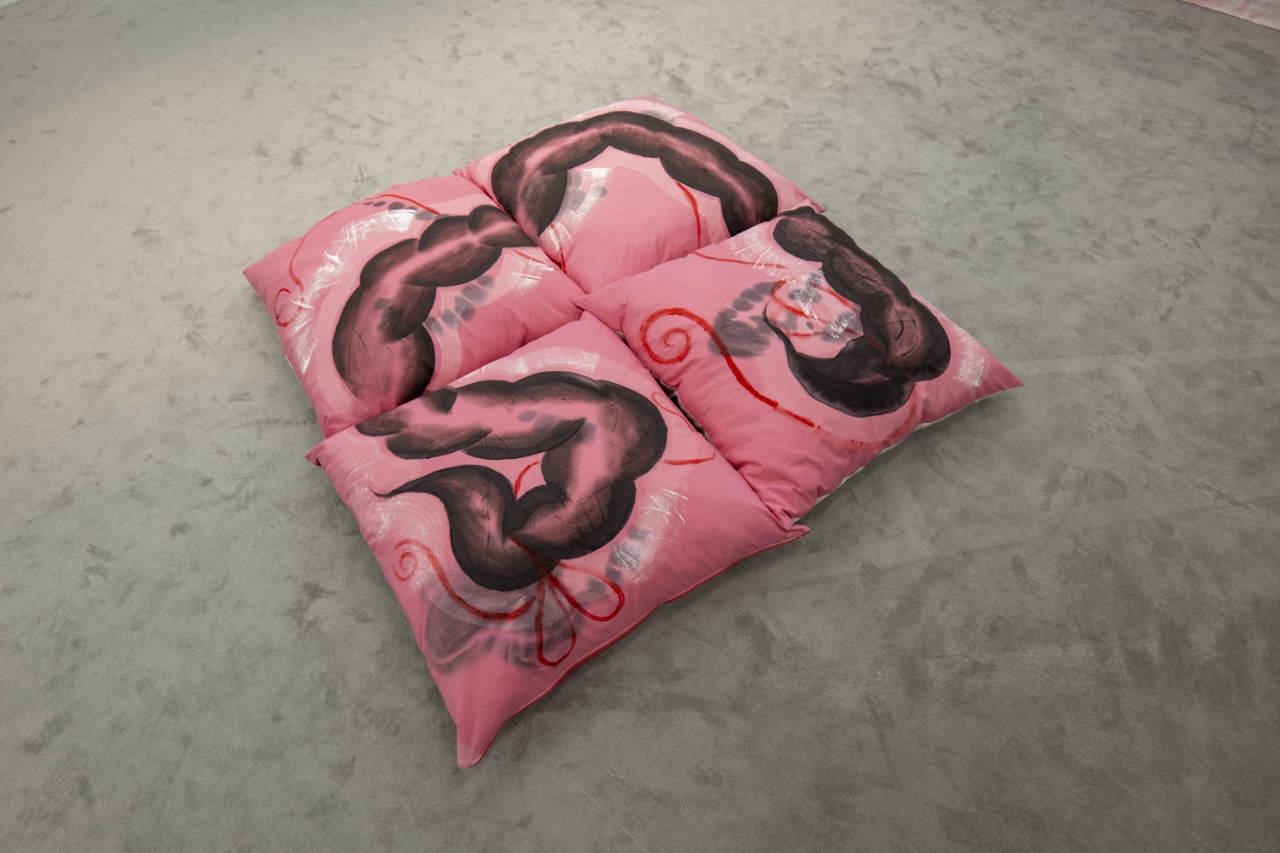
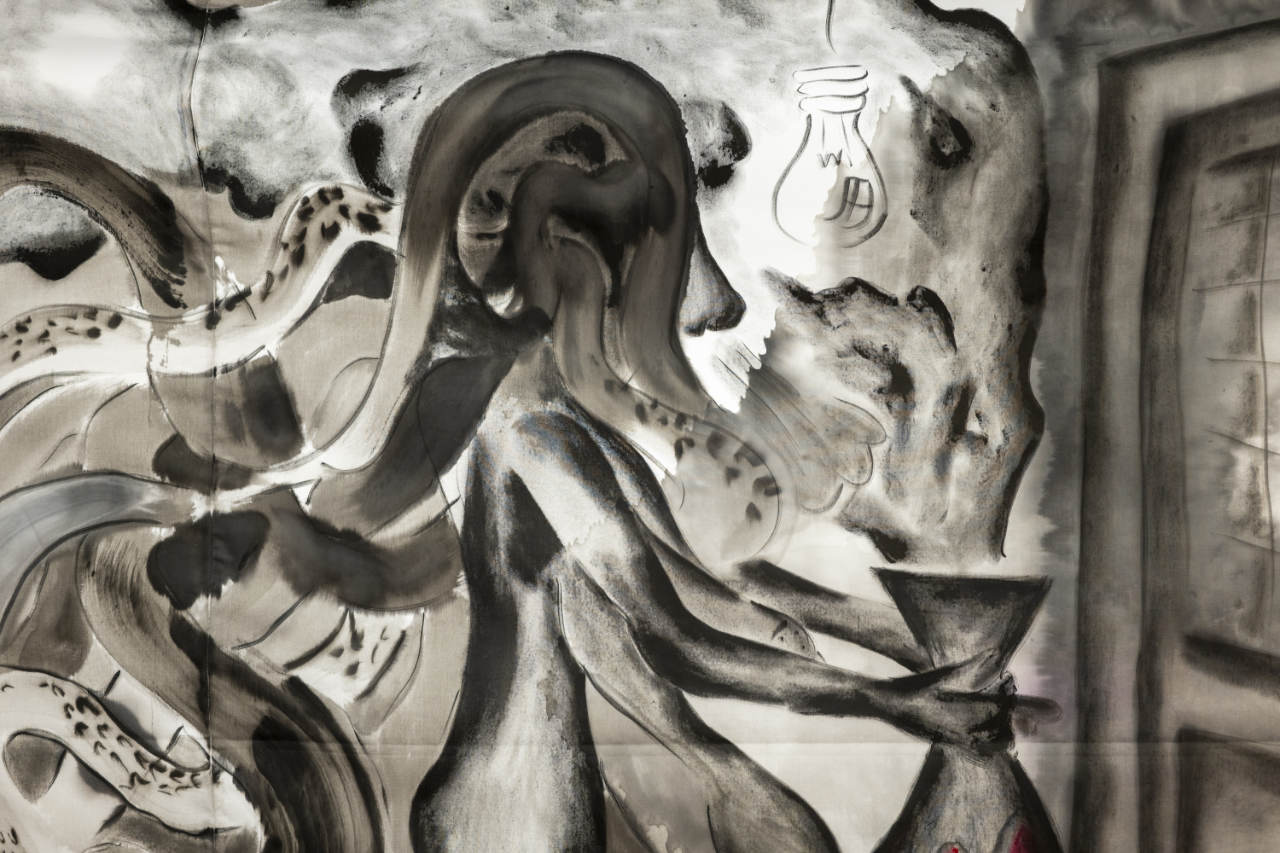
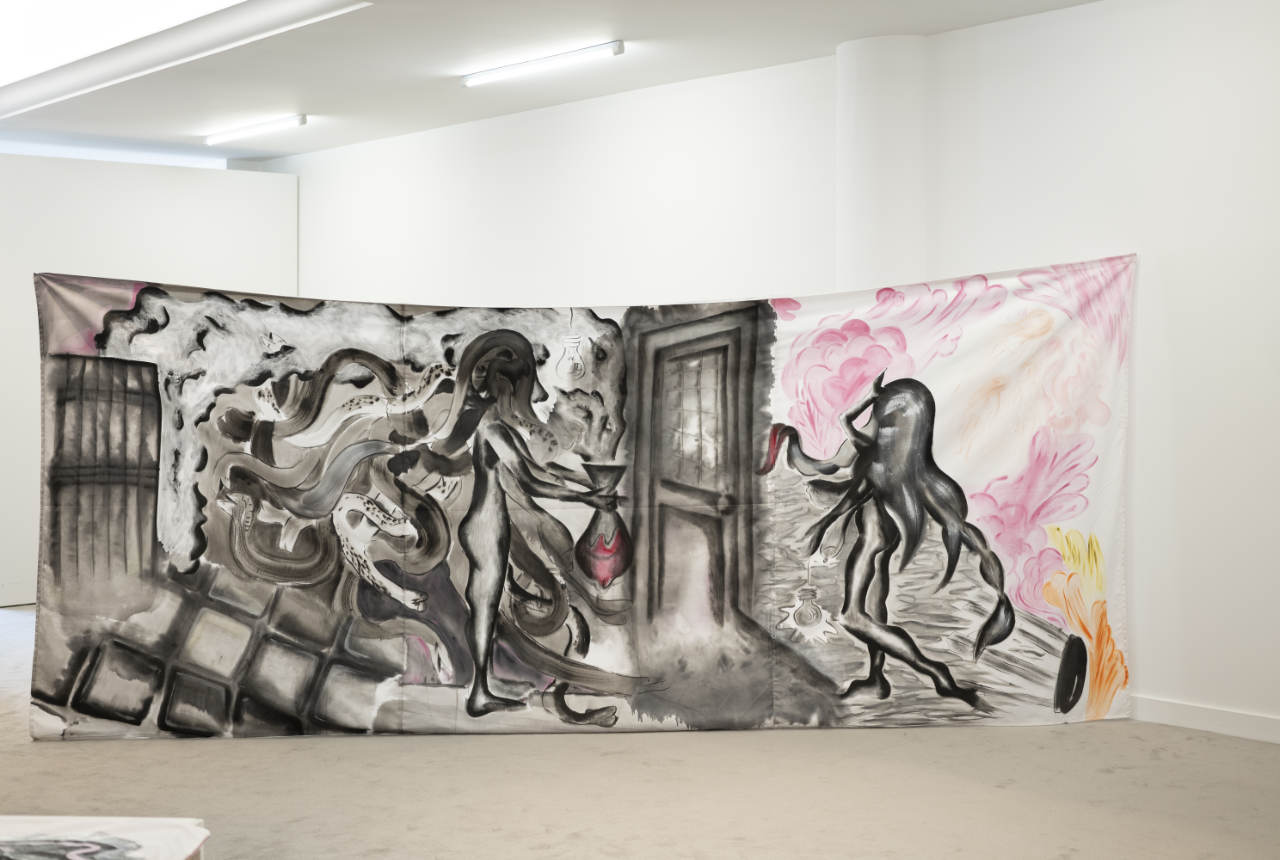
A thread runs through the paintings in Sofia Stevi’s “Song without an ending.” You can follow it across the two monumental paintings draped from the ceilings and on the flip side of the four wide cushions on the floor. I spent the afternoon after seeing these works trying to place this bunched cord’s resemblance to some familiar form: was it a platform of cloud separating one world from another, a worm slithering through Edenic landscapes, a trail of smoke lifted from some painting I had years ago encountered and half-committed to memory? As so often happens, the resemblance came to me in that lucid, half-conscious zone before sleep: it was a glistening intestinal tract, connecting the beginning of this body of work to its end.
I don’t mean by this to suggest that Stevi intended this association, much less that it is the only possible interpretation of paintings characterised by their playful ambiguity and exuberant polysemy. But the image of a living organ running through these paintings helped to clarify some of the feelings that they catalysed in me, and offers a useful way of thinking through their transgression of the boundaries separating one body from another, growth from decay, life from death.
The paintings’ closest point of art historical reference might seem initially to be Surrealism: in their flowing shapes is same emphasis on the instinctual, the emotional and the biomorphic that defined that movement against the rectilinear, geometric, carefully calculated structures of Cubism. Yet while the work of predecessors like Leonora Carrington or Ithell Colquhoun explore the unconscious and the spirit realms, Stevi’s fabrics are rooted in the physical world of matter and change. Indeed, their intellectual context is not esotericism or psychoanalysis but the new materialism illuminated by recent advances in the physical sciences and articulated by philosophers and poets from Karen Barad to Mei-mei Berssenbrugge (from whom the title of this text is borrowed). This is a world in which all things are mixed into each other, time is nothing like linear, bodies are endlessly in flux, dream is a basic construct of our everyday experience, and matter is inseparable from form.
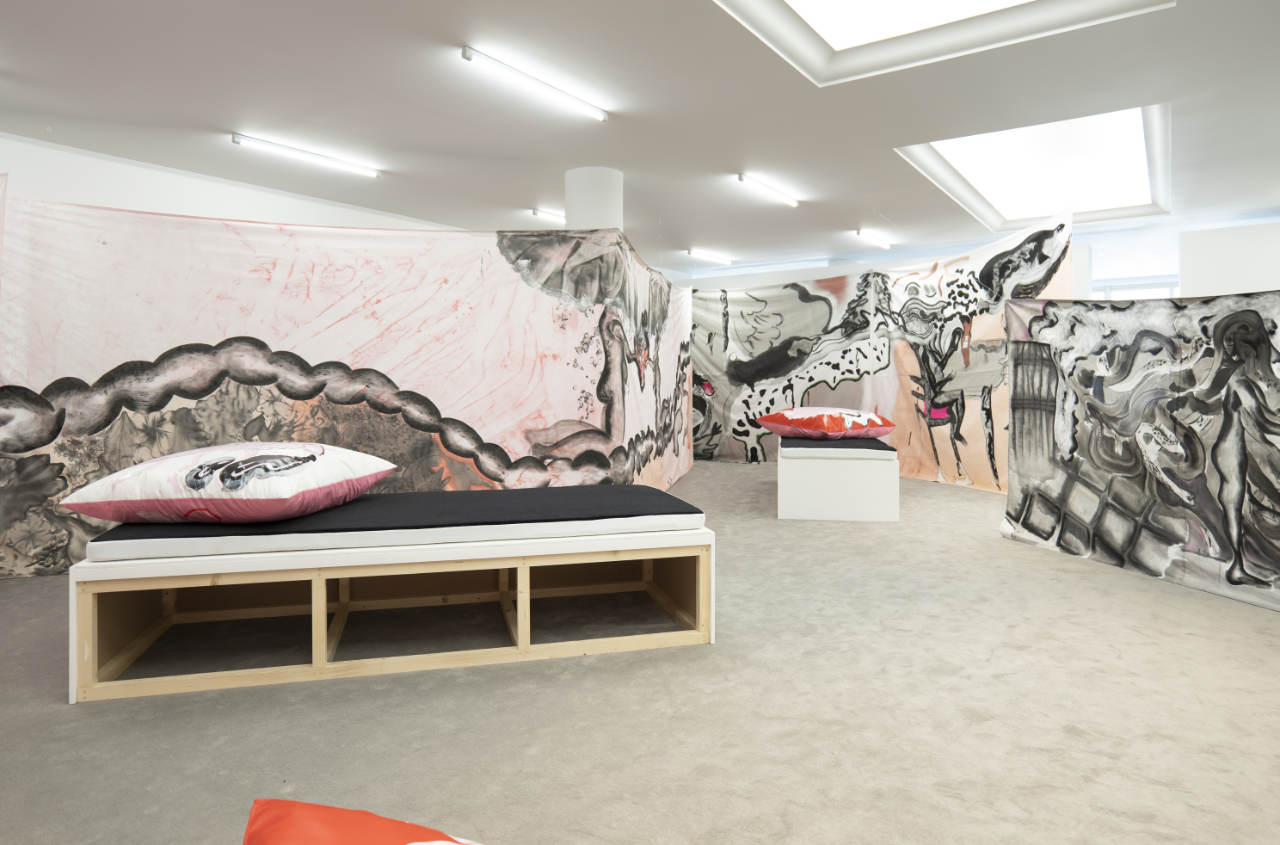
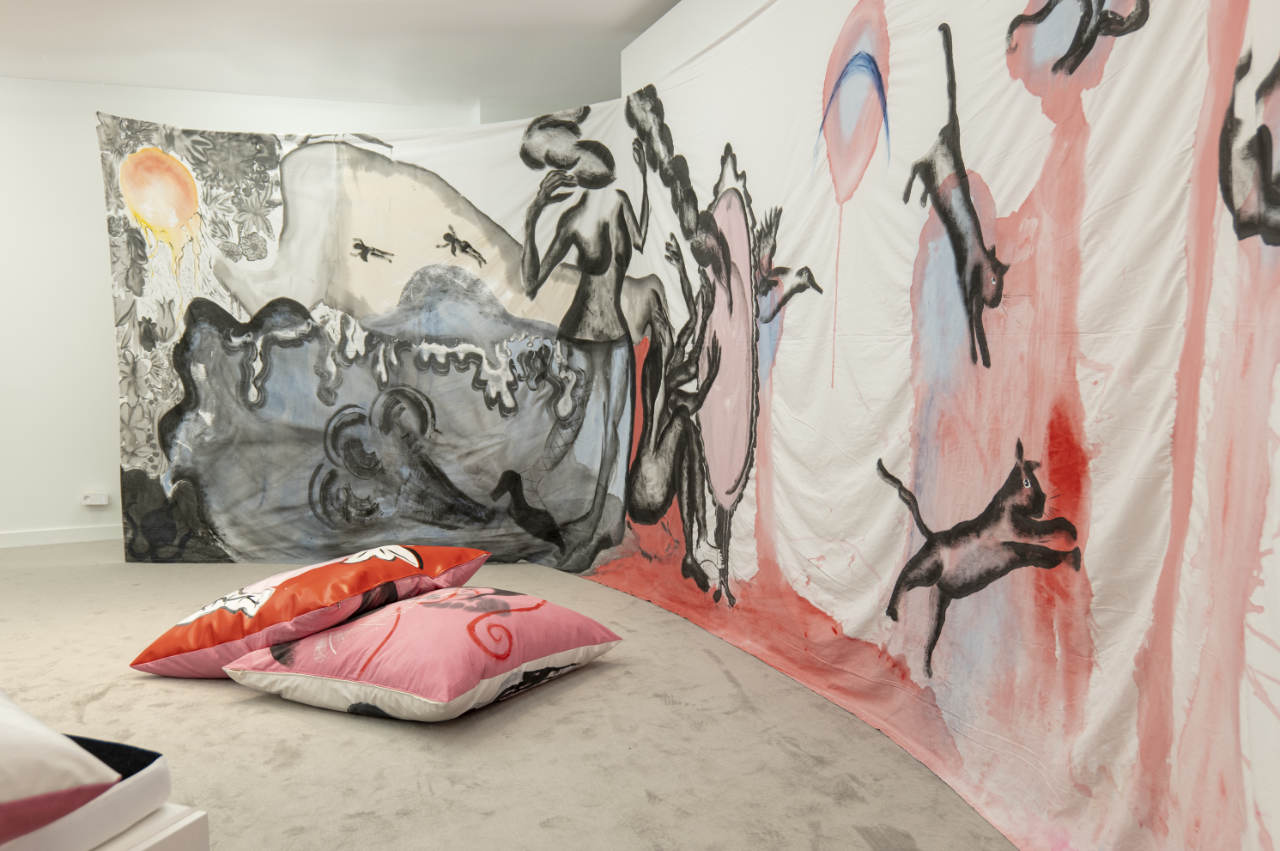
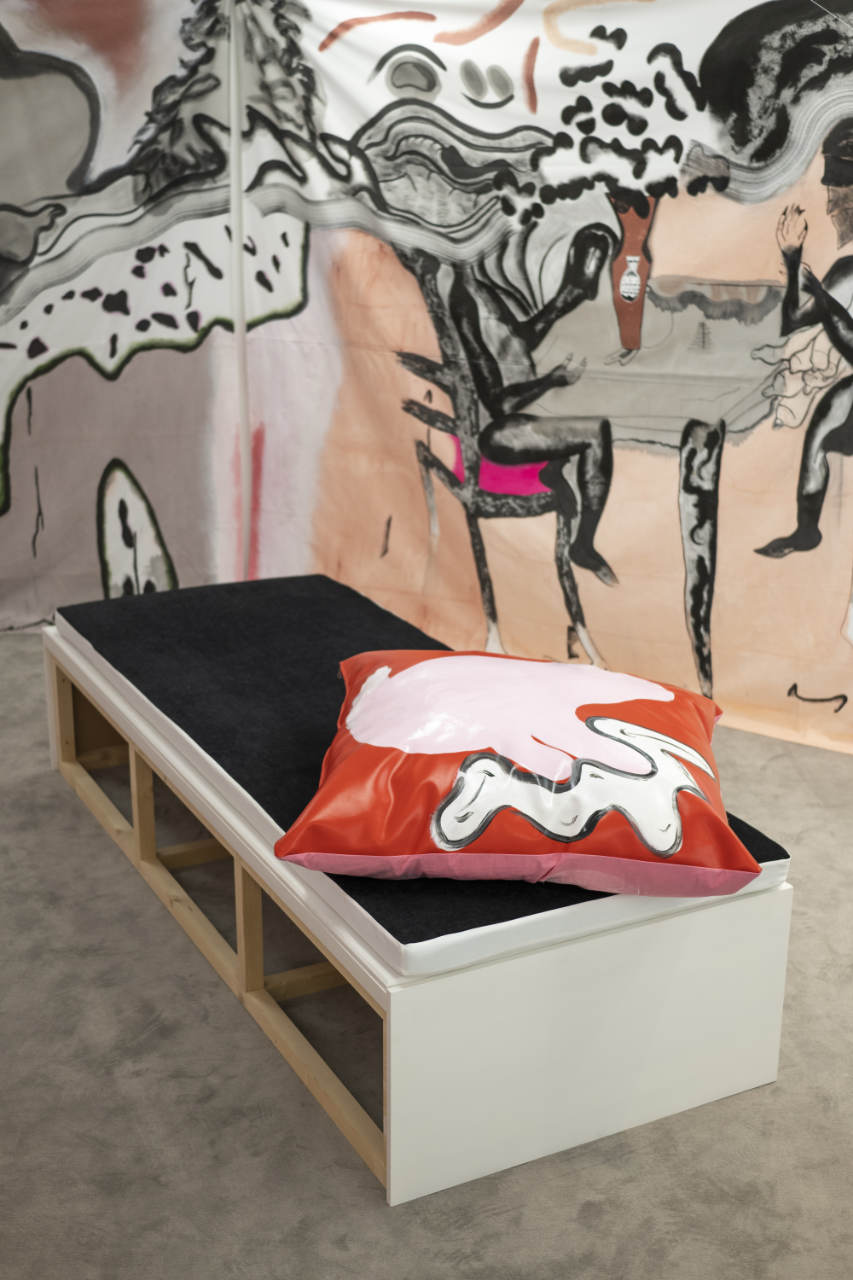
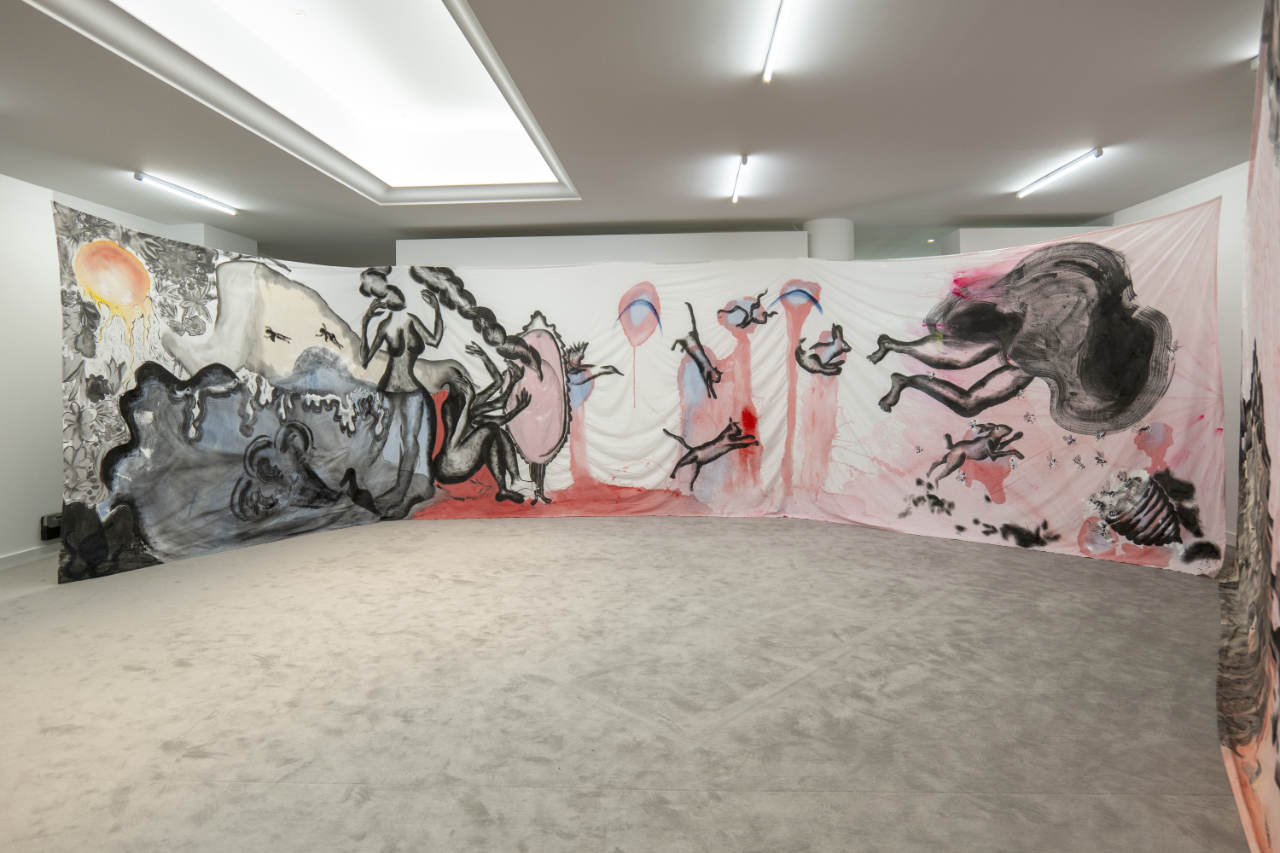
Even the viewer’s experience of this work is embodied: we walk around Stevi’s draped fabrics and sit on her cushions; we follow her more-than-human figures around the room as they are born, dance, suffer, and are transformed. This feeling of immersion might have been accentuated by my encountering the works in the more cramped confines of the artist’s studio, where it was only possible to hang “joyride” by running it around the four walls of a smaller room. It begins, if a never-ending song begins anywhere, with what I first read as a melting sun in the top left-hand corner. This gives life to the burst of flowers, plants and tendrils that overwhelm the painting’s opening section. This first entanglement of death with life—we made, after all, from the stuff of exploded stars—sets the tone for a narrative in which suffering and desire are not only inextricable but caught in a loop. It later occurred to me that this lit opening might also be a mouth seen from the inside, through which matter enters a body to be transformed in the course of the intestines’ looping passage through it into the materials that replenish our bodies. Whether the journey begins with a burning star or a mouth leading into the body, it ends in a black hole.
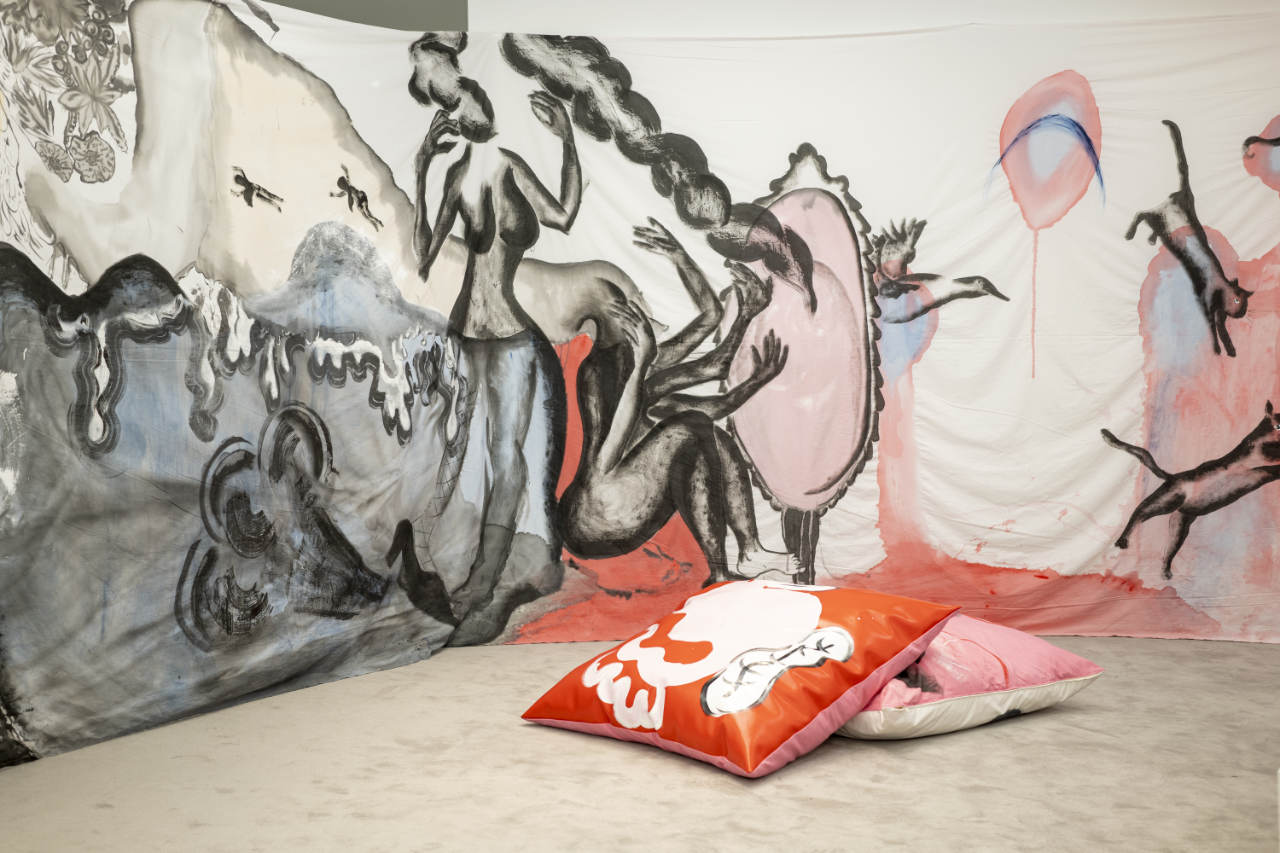
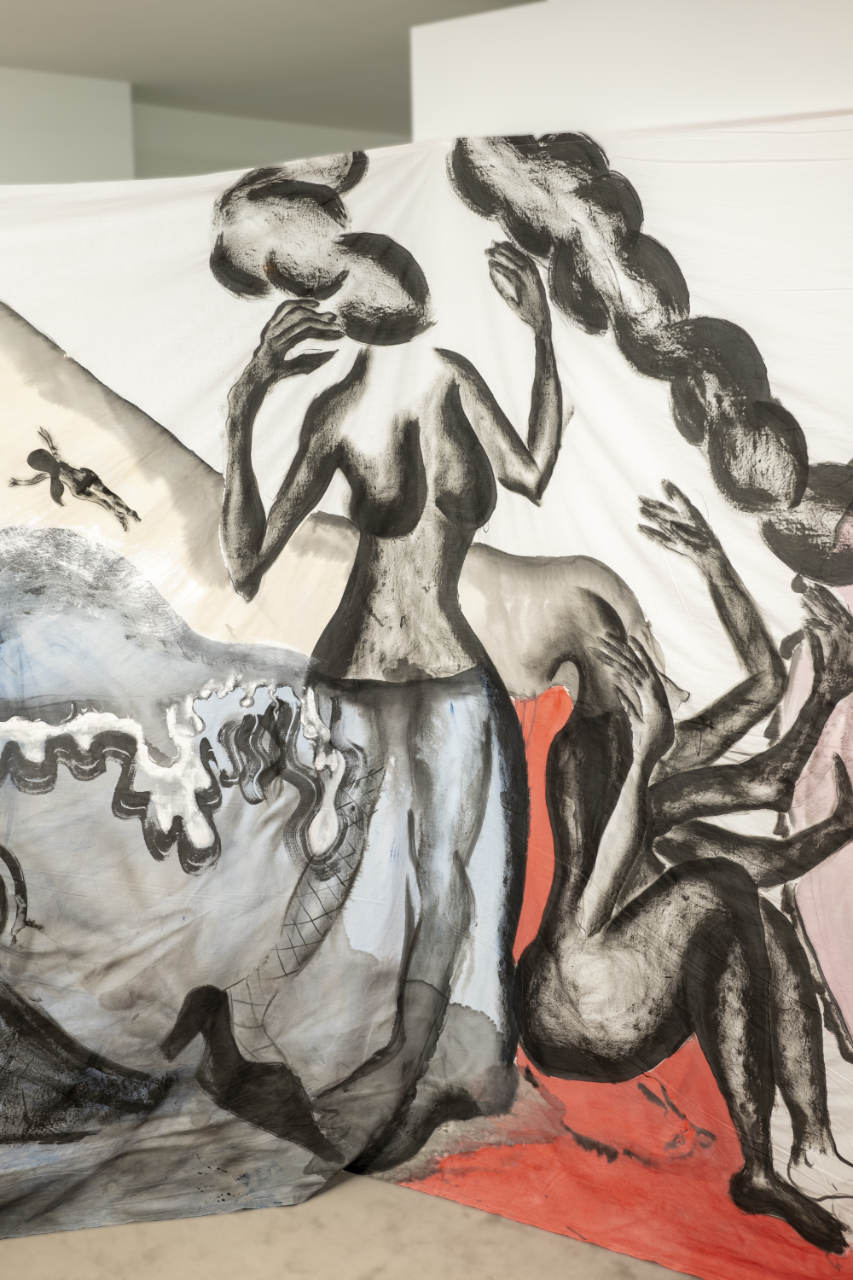
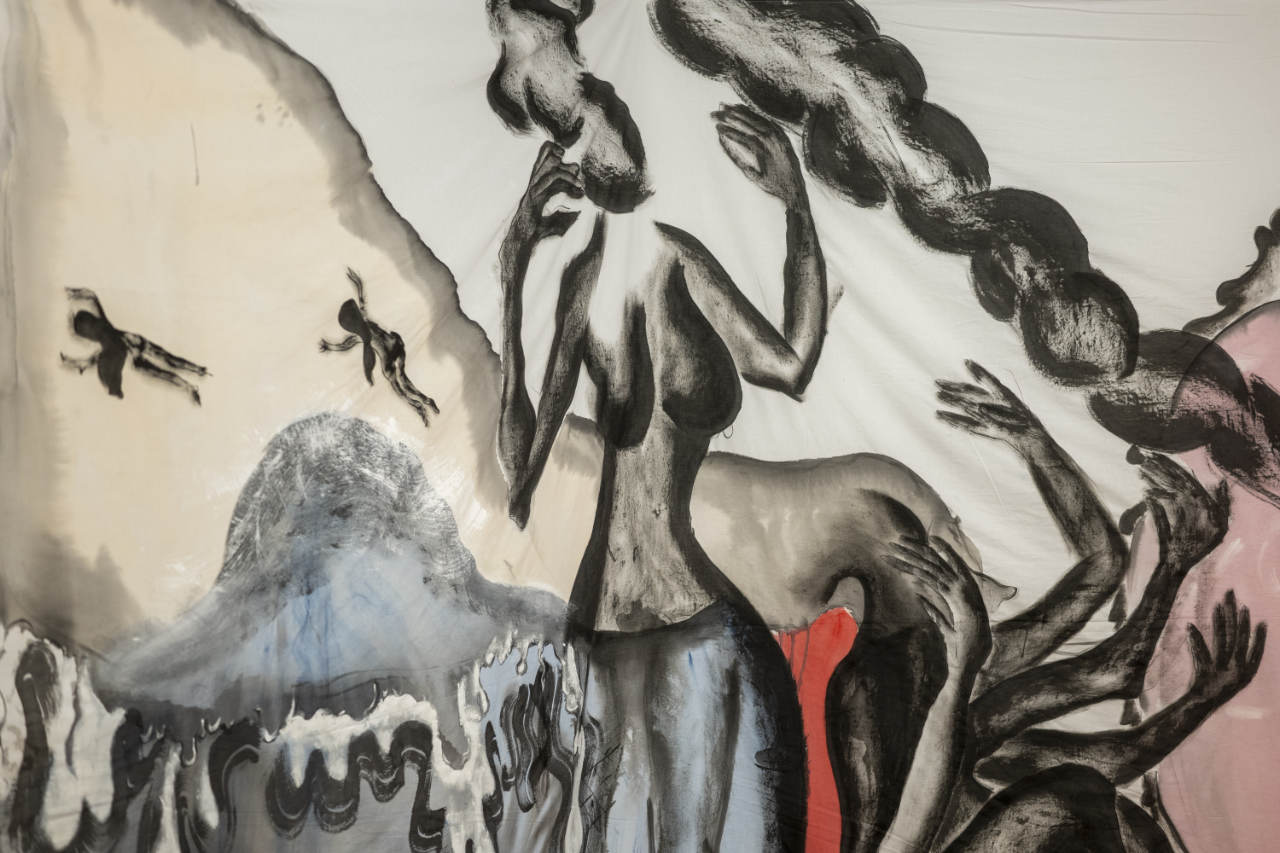
Because I experienced the painting as a circular narrative within which I was literally enclosed, it seemed natural to me that the hole at its end leads us in grand cycle back to the hole at the beginning. Yet the presence at the centre of the painting of a mirror into which a woman gazes, and out of which flies a bird, suggests that the story is not structured as a simple narrative cycle but more like a poem, using patterns, rhymes, rhythms, and variations on a theme to unsettle the idea that a story progresses in straight lines. Instead we move backwards and forwards: the mirror is both a transformative portal (as in Cocteau’s Orphèe or Lewis Carrol’s Wonderland) and a doubling back of what comes in front of it.
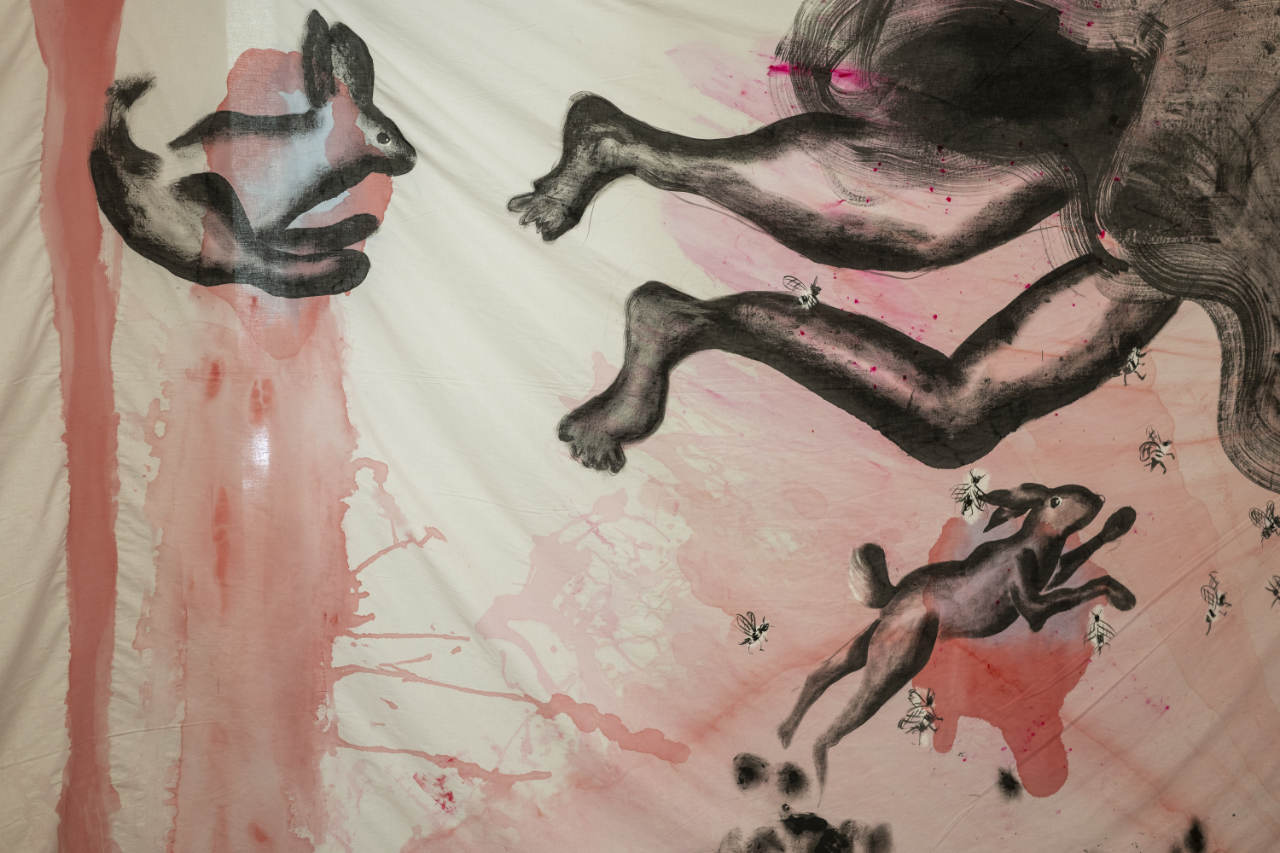
The looking glass might be the most explicit symbol of metamorphosis, yet to confine the painting’s representation of change to a series of discrete stages would be to ignore what’s happening in the rest of it. Everything is always in the process of transforming into something else. All bodies are in motion (take the woman in front of the mirror and her waving arms), and not necessarily in the same direction, as further demonstrated by a convoy of hares running against the prevailing arrow of time from left to right.
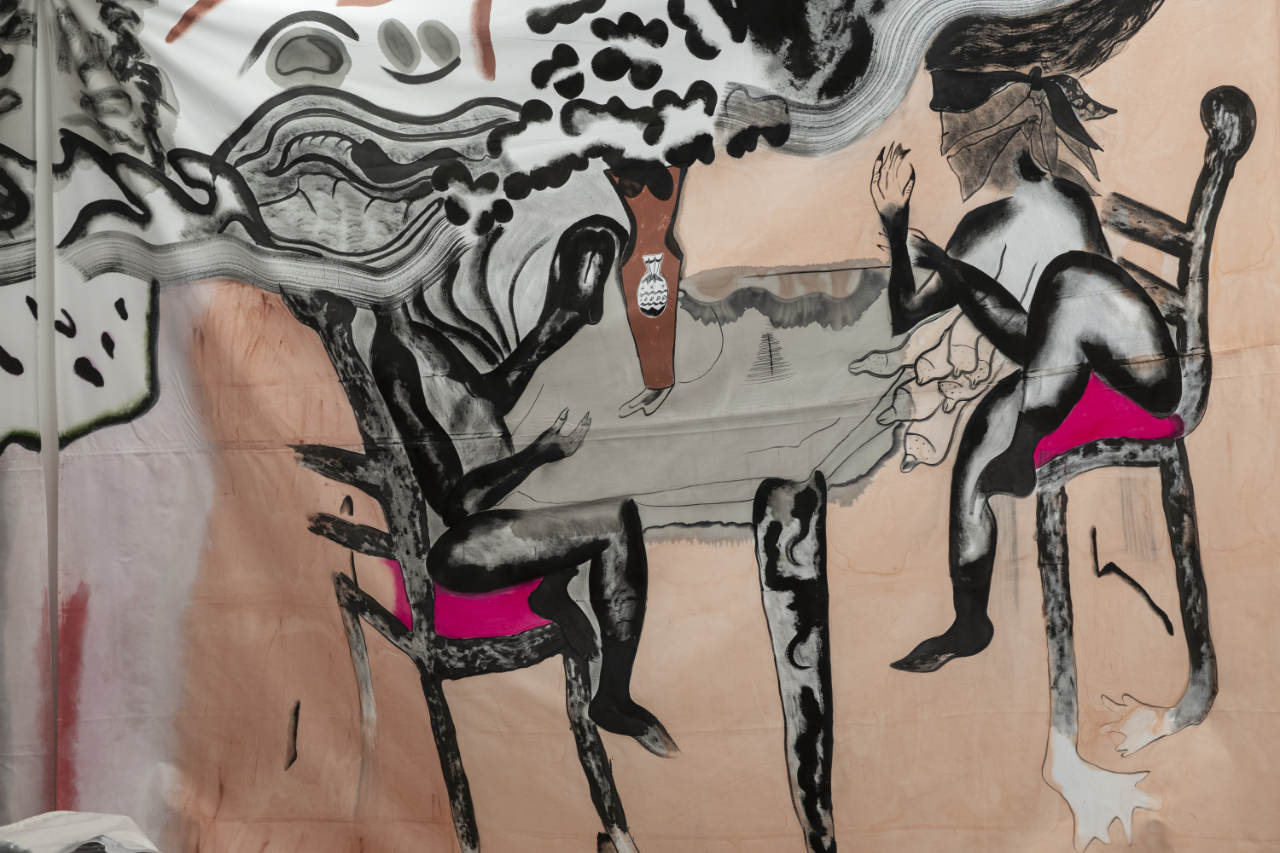
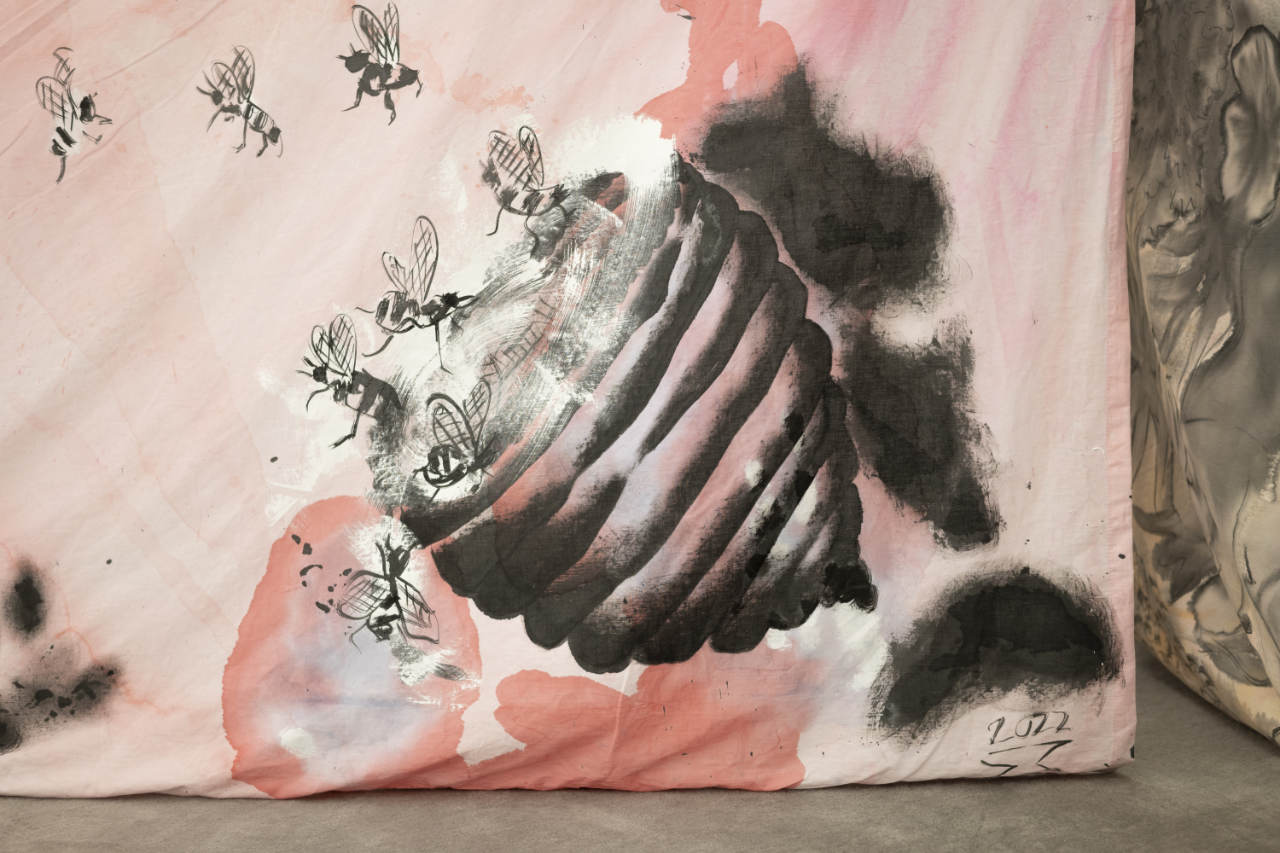
We naturally associate painting with an attempt to fix a moment in time, yet the world of Stevi’s paintings is, like our own, in a constant state of becoming. This “liveliness” is expressed in its materials as much as its subject matter: Stevi stains her nearly translucent cotton fabric with a heavily diluted gouache, generating blooms that can only partially be anticipated, and then paints over it in India ink and acrylic. There is no cartoon or preparatory sketch: one shape suggests another, and so the story unfolds not according to a preordained scheme but in response to the properties that emerge through the unpredictable interaction of disparate materials and ideas. This method lends the work its immediacy as well as the overwhelming impression that it contains a multitude of unrealised possibilities: that like a piece of improvisatory music it might have developed along very different lines had the player chosen a different series of notes in the opening bars of the performance. The same could be said, of course, of a life.
Which returns me to the connective tissue that winds through these paintings. If you arrange the four cushions into a square you’ll see the same cord binding them into a circle like the snake that eats its tail (albeit that its extremities curl up like a scorpion’s sting). On the obverse, fixed in acrylic, are painted four discrete species of animals. Thus what might on the surface appear to be individuated beings are secretly linked by the same filament that stitches together all living things. The more time I spend with the paintings, the more I see this organ pulsing and pushing peristaltically through the paintings’ bodies, a living force like that which “through the green fuse drives the flower” in Dylan Thomas’s poem.
Thomas goes on to write that the same force that “drives our green age” must also be our “destroyer,” and his poem ends on the image of worm eating its way through the shroud that covers the buried body of a dead lover. I was startled to learn, then, that some of the nearly translucent cotton sheets on which Stevi paints are designed for the same purpose of wrapping cadavers in preparation for their return to the soil. The line running through these works is recast as a symbol of our mortality, not only feeding the bodies in the paintings but feasting upon them. The living are born of the dead; desire feeds on suffering.
Yet both Thomas’s poem and Stevi’s paintings make clear that such binary formulations are trite simplifications. Together they reflect a recent shift in western thought away from the categorical distinction of individual organisms from their environments and towards a more complex and holistic understanding of how matter and consciousness are twined through the world. We are coming to appreciate how entangled we are with the bacteria that live in our guts, with the airborne viruses we inhale and transmit, with the plants and animals that we feed on and that will eventually, after a series of transformations, feed on us. There is no end and no beginning but only transformation, the world reborn in every moment and held together by nothing more substantial than the shimmer of cast silk.
That I find this idea liberating might explain why I find joy in these paintings rather than despair. We are never exiled from the realm of life, we simply take new forms within it. Take the legs disappearing into the black hole on the far-right hand side of “joyride” and compare them to those splash into the sea in Bruegel’s Landscape with the Fall of Icarus (ca. 1555). The death of a mythological hero—the embodiment of human hubris—is relegated by Bruegel to a passage in the bottom right hand-corner that the viewer might easily miss. It has little influence on the painting’s grand scheme, does not dictate its composition, is merely a footnote.
After seeing the landscape, W.H. Auden wrote that the Old Masters “were never wrong” about suffering because they understood the human position in relation to nature. The sun continues to shine on the painted world, “as it had to,” and the flowers keep on growing. The farmer tills his soil, failing to notice the historical event out at sea, because he is focused on preparing the land for the turn of the season. Icarus is absorbed into these cycles, his demise merely one new transformation in an endlessly unfolding reality. A series of revolutions in the sciences have confirmed to us what the poets and painters have always known, and Stevi’s paintings reaffirm: that we are constantly in flux, forever changing, always and inextricably entangled with the world.
All photos by Evan Bourgeau.

Photography by Evan Bourgeau